Australia's National Rugby League (NRL) is to celebrate "Women in League" week, starting yesterday, with themes including sons, raising funds for breast cancer support, and club-related specials to encourage women to attend rugby league games. The week-long celebration of women was started in 2006 to highlight the importance of women to the sport and make the game female-friendlier.
The NRL is planning to celebrate the week in a number of ways, including having teams compete in pink uniforms, and having fans vote for the NRL player fans believe "acts as a role model for mothers and families; someone who continues to impress us on the field, however their off-field characteristics embody what it is we love about rugby league". Additionally, funds are to be raised for the McGrath Foundation, a charity dedicated to breast cancer support and education, and the Women in League Achievement Award will be given out with the winner earning a AU$5,000 gift card to Harvey Norman, an Australian electronics store.
The NRL has been promoting the event on their Women in League Facebook page. In the past month, their Facebook updates have included posts featuring male players discussing support they received from women in their lives, sales of pink coloured NRL merchandise, plugs encouraging people to vote for their favourite son, pictures of men supporting Women in League, NRL club promotions for tickets and other events connected to Women in League, and information on a school visit promoting anti-bullying. The Facebook page has also promoted women's participation and profiles of women's players as recently as a month ago, when on April 9, it promoted the Girls 'Come and Try' Day in Canberra. Prior to that, women were last promoted as players on February 10 when pictures were shared of the Women's All Stars team match with the Indigenous All Stars team.
140,000 women in Australia are involved with rugby league as players, sport administrators, coaches, employees, club members, or volunteers. Karen Hardy of The Canberra Times estimates this number could easily be quadrupled if wives, girlfriends, mothers, and other female family members who support male players were included. Participation is also increasing, with almost a thousand new female players taking up the sport between 2011 and 2012 for 5,801 total registered female players in 2012.
Sources
- Rugby League’s One Community. About Women in League — National Rugby League, May 14, 2013 (access date)
- About Us — McGrath Foundation, May 14, 2013 (access date)
- Rugby League’s One Community. Harvey Norman Women in League — National Rugby League, May 14, 2013 (access date)
- National Rugby League. Women in League — Facebook, May 14, 2013 (access date)
- Karen Hardy. What women really want — The Canberra Times, May 11, 2013
- Simon McGuinness. Women in League Function – 100-4-100 — Canberra Raiders, May 8, 2013
Source & Attribution
Originally published by Wikinews on May 14, 2013. Original author: Wikinews.
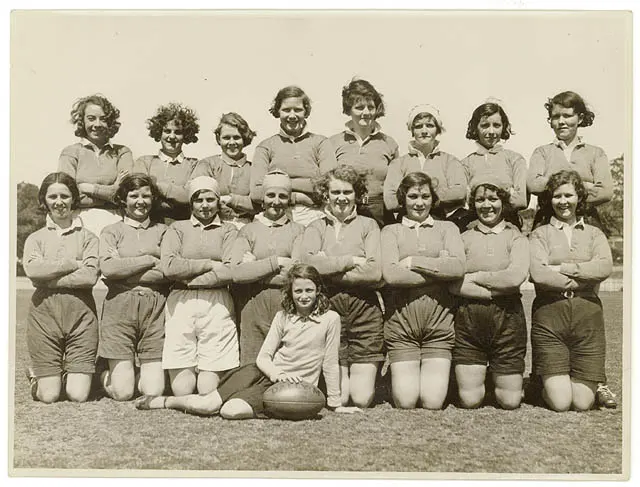
CC BY 2.5. Photograph: A women's rugby team from Australia in the 1930s
Image: Sam Hood. Photo: Sam Hood State Library of New South Wales, Australia Source file. Public domain. Public domain.
Disclaimer
This article retains its original publication date. Subsequent corrections and updates supplied by the source are retained when available. Thames Weekly is not affiliated with or endorsed by the original publisher unless expressly stated. Text and photographs remain credited to their respective creators.