Four New York farms are refusing to honor union contracts put in place by state-appointed arbitrators — the first such contracts to be reached after a 2019 state law granted farm workers collective bargaining rights.
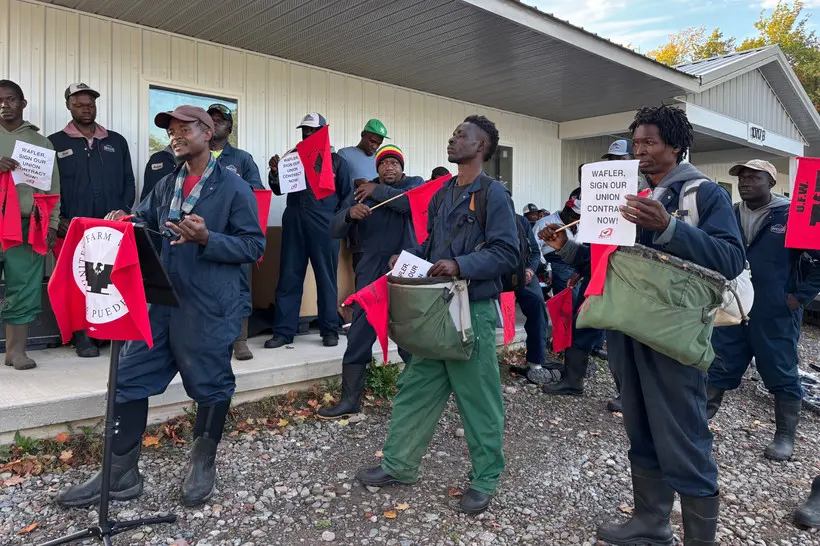
In May, New York Focus reported that Wafler Farms, an upstate apple orchard, was not paying workers the minimum wages stipulated by its union contract, among other violations.
Now, three more large family farms — A&J Kirby Farms and Lynn-Ette & Sons Farms in Orleans County, and Porpiglia Farms in Ulster County — are refusing to abide by contracts, New York Focus has learned.
Arbitrators awarded the contracts at each farm after the owners refused to participate in the arbitration process laid out under the law. Lynn-Ette and Kirby have not signed their respective contracts, while an attorney for Porpiglia told New York Focus that the owner does not intend to follow the contract reached there last week.
The contracts, which are similar across the four farms, include protections like higher wages, health care benefits, and either access to a union pension plan or contributions to a retirement plan.
Kirby’s contract went into effect on June 1, and the apple farm has not been paying workers the contract wage, among other violations, according to the United Farm Workers, the union that represents the workers at all four farms.
“Kirby Farms continues to assess the appropriate next steps,” attorneys from the law firm Fisher Phillips, which is representing the farm, said. “Kirby Farms remains committed to securing a fair process and protecting the voice and rights of workers.”
At Lynn-Ette, a vegetable farm, a contract took effect July 1, and workers have not received any indication that farm management will follow it, the union said. The farm did not respond to a request for comment.
Kirby and Porpiglia told New York Focus through their attorneys that they do not believe the UFW has majority support on their farms.
An attorney for Porpiglia told New York Focus that the farm “will not agree to a union contract drafted by third-party union organizers when there are objections from the workers themselves,” referring to workers who oppose the union.
Farm workers have historically been excluded from federal union protections. Workers have formed unions on 15 farms around the state since New York granted them collective bargaining rights and other labor protections in 2019. But organizers say the farm owners are undermining that victory.
“What does the right to unionize mean if farms can refuse to implement lawful union contracts with impunity?” said Armando Elenes, secretary-treasurer of the UFW.
The 2019 law stipulated that if contract negotiations between unions and farm owners reach an impasse, the matter will be taken up by a neutral arbitrator. Farm workers can’t legally strike under the law, so the arbitration provision was included as a compromise to ensure employers could not perpetually delay bargaining.
Lynn-Ette, Kirby, and Porpiglia, along with the New York State Vegetable Growers Association, have sued to challenge multiple aspects of the law, including the arbitration process.
Kirby’s attorneys told New York Focus that the farm “refused to participate” in arbitration “to preserve its right to challenge” the legality of the process.
The lawsuit also challenges the right of people on guest worker visas to unionize. Many of the workers covered by the UFW contracts are seasonal laborers who travel to the US each year on guest worker visas, mostly from Jamaica and Mexico.
So far, courts have sided against the farm owners and upheld the law.
Wafler Farms has launched its own legal battles. In May, it brought a lawsuit in state court challenging the terms of the union contract arbitrators awarded. It is separately suing to dispute the legitimacy of the union on its farm, echoing other farms’ argument that people on certain work visas do not have union protections. Seasonal workers there told New York Focus that they had hoped the contract would provide them with job security and stop the verbal abuse they faced from their boss.
“Everybody was tired of this type of situation where if you see something wrong, and you try to talk about it, there is a backlash coming,” one worker said.
The ongoing lawsuits do not free farms of the obligation to follow union contracts, said Gali Racabi, a professor at Cornell Law School who specializes in labor law. “Not following it would be both a contract foul and a New York state law foul,” Racabi said.
The UFW said it will take legal action to enforce the contracts if the farms do not voluntarily follow them. The state Public Employment Relations Board, which handles New York public sector labor disputes and oversees the agricultural unions, could also choose to bring the farms to court to force them to comply, but has not yet indicated if it will do so.
“The farm employers should obey the law,” a spokesperson for the board told New York Focus.
Mario Cilento, president of the New York state AFL-CIO, which advocated for the 2019 law, said that if owners won’t uphold their part of the bargain, workers will escalate.
“If farm employers refuse to honor arbitration awards, we have no choice but to fight to codify the right to strike,” he said.
Source & Attribution
Originally published by New York Focus on July 2, 2025. Original author: Julia Rock.
Original headline: New York Farms Refuse to Follow New Union Contracts.
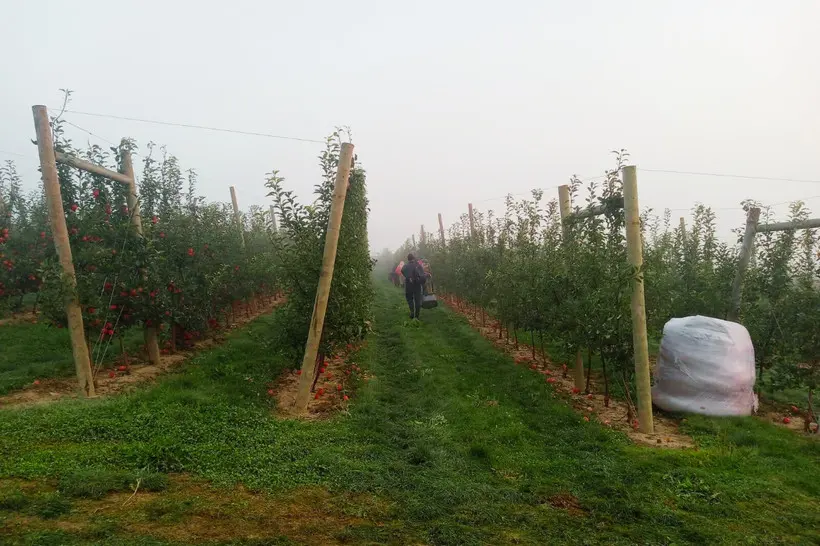
CC BY-ND 4.0. Photograph: Workers pick apples at Wafler Farms. | Courtesy of a Wafler Farms worker CC BY-ND 4.0; original same-story photo only, retain caption/credit..
Disclaimer
This article retains its original publication date. Subsequent corrections and updates supplied by the source are retained when available. Thames Weekly is not affiliated with or endorsed by the original publisher unless expressly stated. Text and photographs remain credited to their respective creators.