On Monday, scientists from the Stanford University School of Medicine announced the invention of a new diagnostic tool that can sort cells by type: a tiny printable chip that can be manufactured using standard inkjet printers for possibly about one U.S. cent each. Lead researchers say this may bring early detection of cancer, tuberculosis, HIV and malaria to patients in low-income countries, where the survival rates for illnesses such as breast cancer can be half those of richer countries.
Existing methods tend to identify cell types using fluorescent or magnetic labels, which take time to attach, but this platform uses the phenomenon of dielectrophoresis: because different kinds of cells have different levels of receptivity to electrical fields, a trait called polarizability, when an electric potential gradient is activated around the chip, different cells are pulled in different directions at different speeds. This allows doctors to diagnose cancer by determining the number of tumor cells in a patient's blood sample. Different chips can be printed to diagnose different diseases.
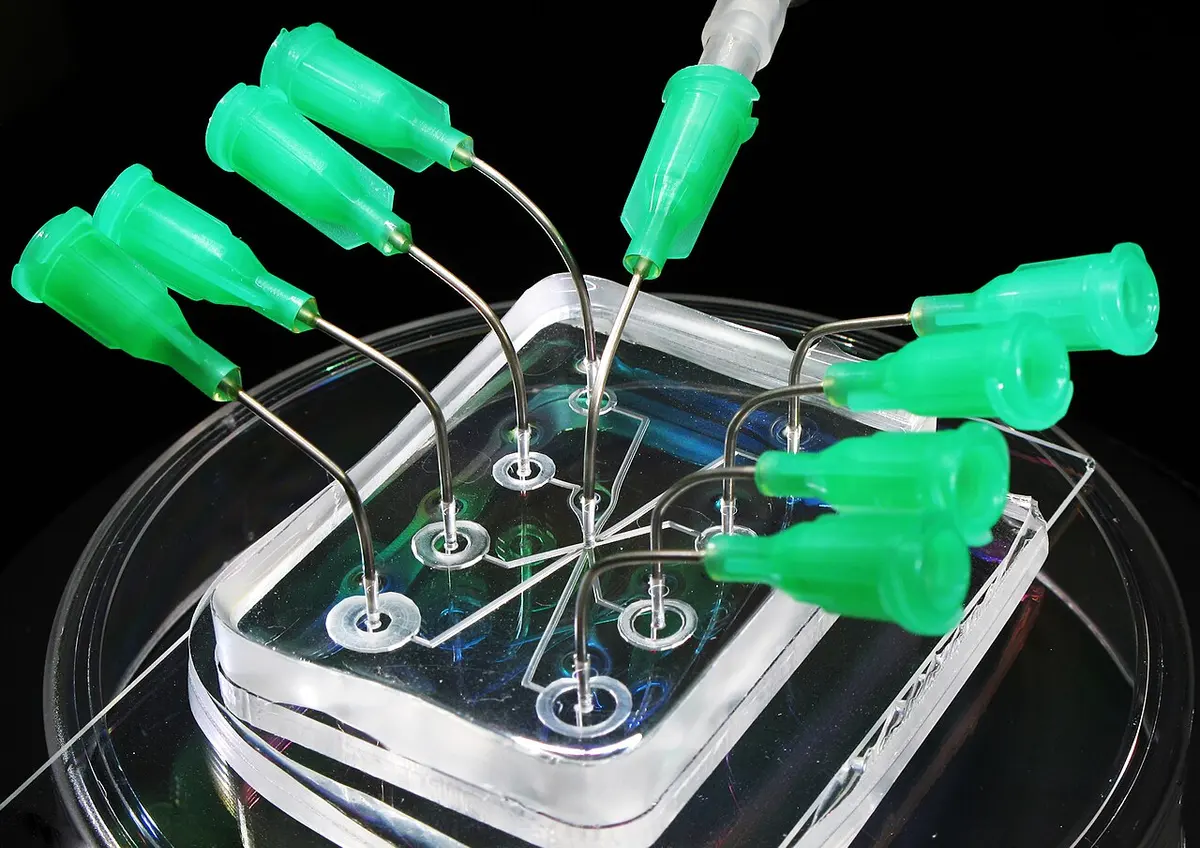
Physically, the scientists say, the system has two parts. Cells are held in a clear microfluidic chamber made of silicone. The chip itself is an electronic strip that can be printed onto flexible polyester. Most lab-on-a-chip devices must be manufactured by professional staff in specialized facilities called clean rooms and can take weeks, but the chip component of this system can be made almost anywhere in as little as twenty minutes. The chips cost approximately one U.S. cent to produce (US$0.01) and can be reused. For comparison, a standard flow cytometry machine can cost US$100,000 to purchase.
"Enabling early detection of diseases is one of the greatest opportunities we have for developing effective treatments," said lead author and electrical engineer Dr. Rahim Esfandyarpour. "Maybe $1 in the U.S. doesn't count that much, but somewhere in the developing world, it's a lot of money."
Senior author Dr. Ron Davis of the Stanford University Genome Technology Center compared this invention to that of low-cost genome sequencing, which helped lead to personalized medicine.
The findings appeared in the Proceedings of the National Academy of Sciences on Monday.
Sources
- Kendra Pierre-Louis. This cheap and easy lab-on-a-chip could save lives — Popular Science, February 7, 2017
- Stanford University Medical Center. Stanford scientists develop 'lab on a chip' that costs 1 cent to make — Eurekalert!, February 6, 2017
- Rahim Esfandyarpour, Matthew J. DiDonato, Yuxin Yang, Naside Gozde Durmus, James S. Harris, and Ronald W. Davis. Multifunctional, inexpensive, and reusable nanoparticle-printed biochip for cell manipulation and diagnosis — Proceedings of the National Academy of Sciences, February 6, 2017
Source & Attribution
Originally published by Wikinews on February 9, 2017. Original author: Wikinews.
CC BY 2.5. Photograph: Most labs on chips, like this microfluidics chip, require time and expert staff to manufacture.
Image: National Institute of Standards and Technology. Photo: National Institute of Standards and Technology Lab on a Chip Source file. Public domain. Public domain.
Disclaimer
This article retains its original publication date. Subsequent corrections and updates supplied by the source are retained when available. Thames Weekly is not affiliated with or endorsed by the original publisher unless expressly stated. Text and photographs remain credited to their respective creators.